


-
-
npj Precision Oncology Long-term oncologic outcomes of unselected triple-negative breast cancer patients according to BRCA1/2 mutations 2024.06.14.volume 8, Article number: 96 (2024) 논문 보기
Abstract
Triple-negative breast cancer (TNBC) patients are more likely to have BRCA1/2 mutations, with a prevalence rate of about 10–20%. Although several studies have analyzed the oncologic outcomes between BRCA1/2 carriers and non-carriers, the impact on breast cancer patients is still unclear. A retrospective review was performed to determine the long-term outcomes of TNBC patients, focusing on the impact of BRCA1/2 mutations. A total of 953 TNBC patients who underwent primary breast cancer surgery from June 2008 to January 2016 were included. We examined long-term outcomes, including contralateral breast cancer (CBC) incidence, recurrence patterns, and survival rates over a median follow-up of 80.9 months (range 3–152 months). 122 patients (12.8%) had BRCA1/2 mutations. BRCA1/2 mutation carriers were significantly younger at diagnosis and more likely to have a family history of breast/ovarian cancer. CBC incidence at 60, 120, and 150 months was significantly higher in BRCA1/2 mutation carriers compared to non-carriers (P = 0.0250, 0.0063, and 0.0184, respectively). However, there were no significant differences in disease-free survival, overall survival, breast cancer-specific survival, or distant-me
tastasis-free survival between the two groups. BRCA1/2 mutation status was a significant risk factor for CBC (HR = 6.242, P < 0.0001). Interestingly, among 29 patients with CBC recurrence, 24 patients (82.8%) had recurring TNBC subtype and among the CBC recurrence patients, 19 patients (65.5%) resumed chemotherapy. In the TNBC subtype, appropriate genetic testing and counseling are pivotal for surgical decisions like risk-reducing mastectomy (RRM). Furthermore, long-term surveillance is warranted, especially in BRCA1/2 carriers who did not receive RRM. Introduction
Breast cancer comprises subtypes with distinct morphologies and clinical implications. Triple-negative breast cancer (TNBC) is defined by little or lack of ex
pression of estrogen receptor (ER), progesterone receptor (PR), and human epidermal growth factor receptor 2 (HER-2)1. The TNBC subtype has poor oncologic outcomes; a higher risk of early recurrence and a lower risk of late recurrence compared to luminal-type breast cancer2,3,4. Among all breast cancer patients, TNBC patients are more likely to have BRCA1/2 germline mutations, with a prevalence rate of approximately 10–20%5,6,7,8. Results
ba
seline characteristics The ba
seline patient characteristics according to BRCA1/2 mutation are shown in Table 1. All patients were Korean. BRCA1/2 mutation carriers were significantly younger (mean age 45.5 ± 11.0 vs. 50.1 ± 10.8) and premenopausal (63.1% vs. 47.3%) at the time of diagnosis compared to non-carriers (P = 0.002 and P = 0.0011, respectively). Also, BRCA1/2 mutation carriers were more likely to have a family history of breast cancer and/or ovarian cancer (40.2% vs. 9.4%, P < 0.0001), personal history of ovarian cancer (9.0% vs. 0.5%, P < 0.0001), bilateral breast cancer (4.9% vs. 1.2%, P = 0.0105), and a higher nuclear grade (86.0% vs. 73.4%, P = 0.0140). Pathologic stage, lympho-vascular invasion, multiplicity, and proportion of mastectomy were not significantly different in those with or without BRCA1/2 mutation. Although differences in the proportion of adjuvant chemotherapy (81.2% vs. 70.2%, P = 0.0120) and neo-adjuvant chemotherapy (13.1% vs. 21.8%, P = 0.0273) were observed, the total proportion of chemotherapy treatment was comparable between the two groups (94.3% vs. 89.4%, P = 0.1314). Discussion
In our previous study, with a median follow-up period of 53.6 months, we demonstrated the high prevalence of BRCA1/2 mutation in unselected Korean TNBC patients and the higher incidence rate of CBC in BRCA1/2 mutation carriers compared to non-carriers16. With a median follow-up duration of 80.9 months, this long-term follow-up study showed a consistently increased CBC incidence rate in BRCA1/2 mutation carriers compared to non-carriers. There were no significant differences in disease-free survival (DFS), OS, BCSS, and DMFS between the two groups. Additionally, BRCA1/2 mutation was a significant risk factor for CBC occurrence with an HR of 6.242. Among patients with CBC recurrence, ~80% had TNBC-type as recurred CBC, and over 60% resumed chemotherapy.
Total : 35개 (page : 2/3)
-
 Association analysis identifies 65 new breast cancer risk loci
-
 Reproductive factors as risk modifiers of breast cancer in BRCA mutation carriers and high risk
-
 The Effect of Reproductive Factors on Breast Cancer Presentation in Women Who Are BRCA Mutation Carrier
-
 The Management Strategy of Benign Solitary Intraductal Papilloma on Breast Core Biopsy
-
 Prediction of Breast and Prostate Cancer Risks in Male BRCA1 and BRCA2 Mutation Carriers Using Polygenic Risk Scores
-
 Influence of the Angelina Jolie Announcement and Insurance Reimbursement on Practice Patterns for Hereditary Breast Cancer
-
 Suggestion of BRCA1 c.5339T>C (p.L1780P) variant confer from 'unknown significance' to 'Likely pathogenic' based on clinical evidence in Korea
-
 Identification of 12 new susceptibility loci for different histotypes of epithelial ovarian cancer
-
 Failure patterns according to molecular subtype in patients with invasive breast cancer following postoperative adjuvant radiotherapy: long-term outcomes in contemporary clinical practice
-
 Association between basal-like phenotype and BRCA1/2 germline mutations in Korean breast cancer patients
-
 Use of a prospective surveillance model to prevent breast cancer treatment-related lymphedema: a single-center experience
-
 Reliability of Computer-Assisted Breast Density Estimation: Comparison of Interactive Thresholding, Semiautomated, and Fully Automated Methods
-
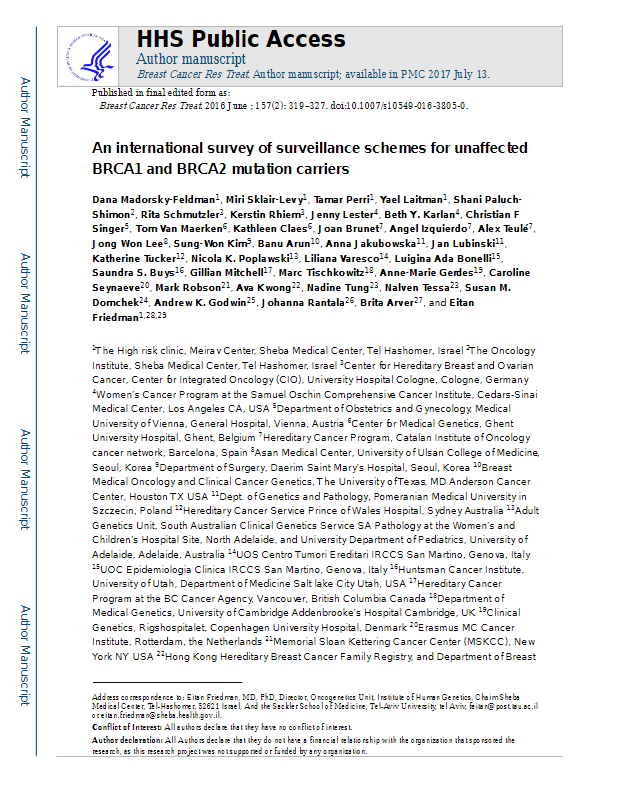 An international survey of surveillance schemes for unaffected BRCA1 and BRCA2 mutation carriers
-
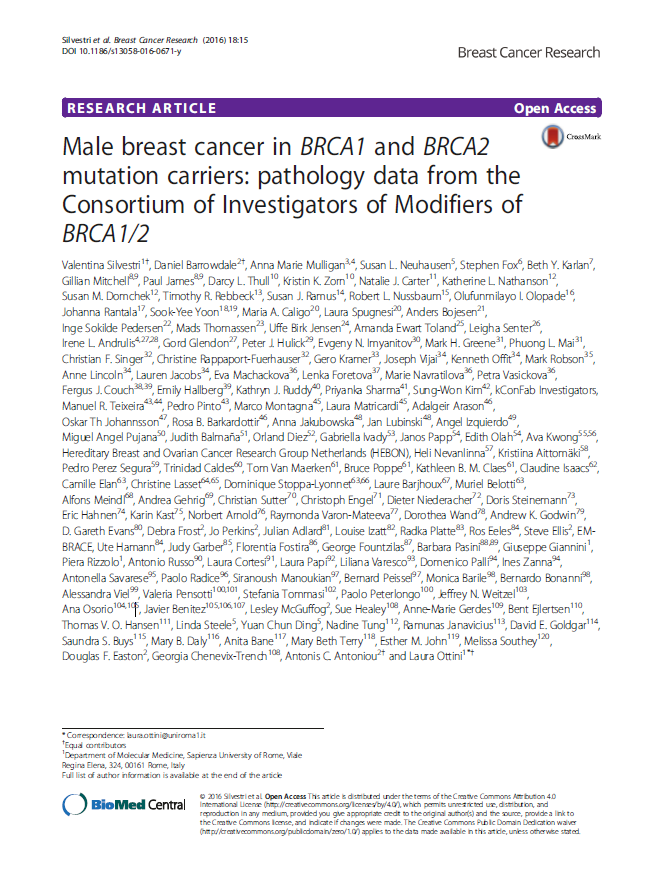 Male breast cancer in BRCA1 and BRCA2 mutation carriers: pathology data from the Consortium of Investigators of Modifiers of BRCA1/2
-
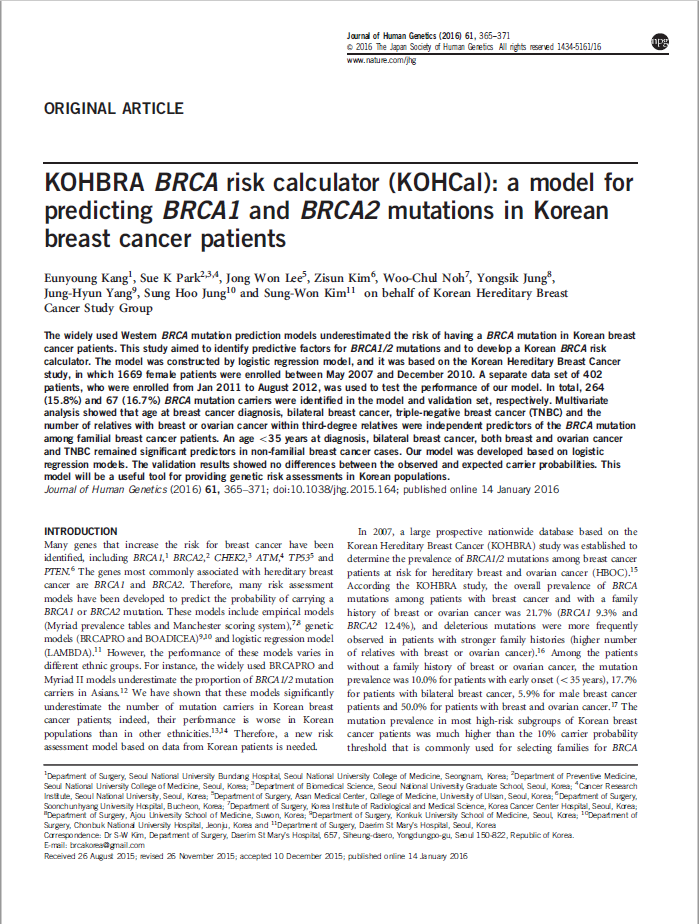 KOHBRA BRCA risk calculator (KOHCal): a model for predicting BRCA1 and BRCA2 mutations in Korean breast cancer patients


