


-
-
Journal of Clinical Oncology Associations of a Breast Cancer Polygenic Risk Score With Tumor Characteristics and Survival 2023.01.27.Volume 41, Number 10 논문 보기
A polygenic risk score (PRS) consisting of 313 common genetic variants (PRS313) is associated with risk of breast cancer and contralateral breast cancer. This study aimed to evaluate the association of the PRS313 with clinicopathologic characteristics of, and survival following, breast cancer.
Women with invasive breast cancer were included, 98,397 of European ancestry and 12,920 of Asian ancestry, from the Breast Cancer Association Consortium (BCAC), and 683 women from the European MINDACT trial. Associations between PRS313 and clinicopathologic characteristics, including the 70-gene signature for MINDACT, were evaluated using logistic regression analyses. Associations of PRS313 (continuous, per standard deviation) with overall survival (OS) and breast cancer–specific survival (BCSS) were evaluated with Cox regression, adjusted for clinicopathologic characteristics and treatment.
The PRS313 was associated with more favorable tumor characteristics. In BCAC, increasing PRS313 was associated with lower grade, hormone receptor–positive status, and smaller tumor size. In MINDACT, PRS313 was associated with a low risk 70-gene signature. In European women from BCAC, higher PRS313 was associated with better OS and BCSS: hazard ratio (HR) 0.96 (95% CI, 0.94 to 0.97) and 0.96 (95% CI, 0.94 to 0.98), but the association disappeared after adjustment for clinicopathologic characteristics (and treatment): OS HR, 1.01 (95% CI, 0.98 to 1.05) and BCSS HR, 1.02 (95% CI, 0.98 to 1.07). The results in MINDACT and Asian women from BCAC were consistent.
An increased PRS313 is associated with favorable tumor characteristics, but is not independently associated with prognosis. Thus, PRS313 has no role in the clinical management of primary breast cancer at the time of diagnosis. Nevertheless, breast cancer mortality rates will be higher for women with higher PRS313 as increasing PRS313 is associated with an increased risk of disease. This information is crucial for modeling effective stratified screening programs.
Total : 35개 (page : 1/3)
-
 Psychosocial barriers and facilitators for cascade genetic testing in hereditary breast and ovarian cancer: a scoping review
-
 Long-term oncologic outcomes of unselected triple-negative breast cancer patients according to BRCA1/2 mutations
-
Associations of a Breast Cancer Polygenic Risk Score With Tumor Characteristics and Survival
-
 Comprehensive clinical characterization of patients with BRCA1: c.5017_5019del germline variant
-
 BRCA and Breast Cancer-Related High-Penetrance Genes
-
 Contralateral Breast Cancer and Ipsilateral Breast Tumor Recurrence in BRCA1/2 Carriers and Non-Carriers at High-Risk of Hereditary Breast Cancer
-
 The functional ALDH2 polymorphism is associated with breast cancer risk: A pooled analysis from the Breast Cancer Association Consortium
-
 Height and body mass index as Modifiers of breast cancer risk in BRCA1/2 mutation carriers: A Mendelian randomization study
-
 Prevalence and oncologic outcomes of BRCA 1/2 mutations in unselected triple-negative breast cancer patients in Korea
-
 Development of a Management Algorithm for the Diagnosis of Cellular Fibroepithelial Lesions From Core Needle Biopsies
-
 Reclassification of BRCA1 and BRCA2 variants of uncertain significance: a multifactorial analysis of multicentre prospective cohort
-
 BRCA1/2-negative, high-risk breast cancers (BRCAX) for Asian women: genetic susceptibility loci and their potential impacts
-
 Impact of Nodule Size on Malignancy Risk Differs according to the Ultrasonography Pattern of Thyroid Nodules
-
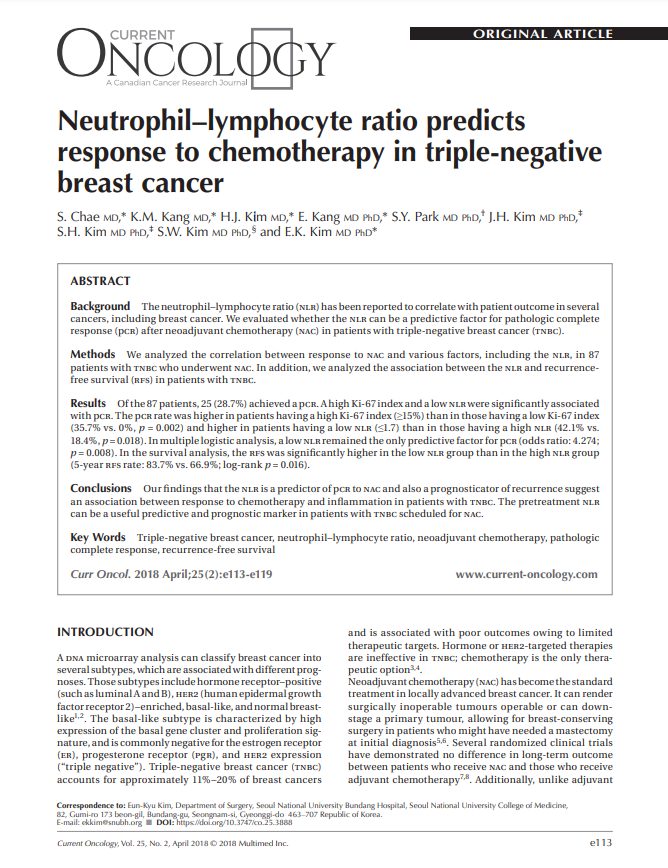 Neutrophil–lymphocyte ratio predicts response to chemotherapy in triple-negative breast cancer
-
 Identification of ten variants associated with risk of estrogen-receptor-negative breast cancer


