


-
-
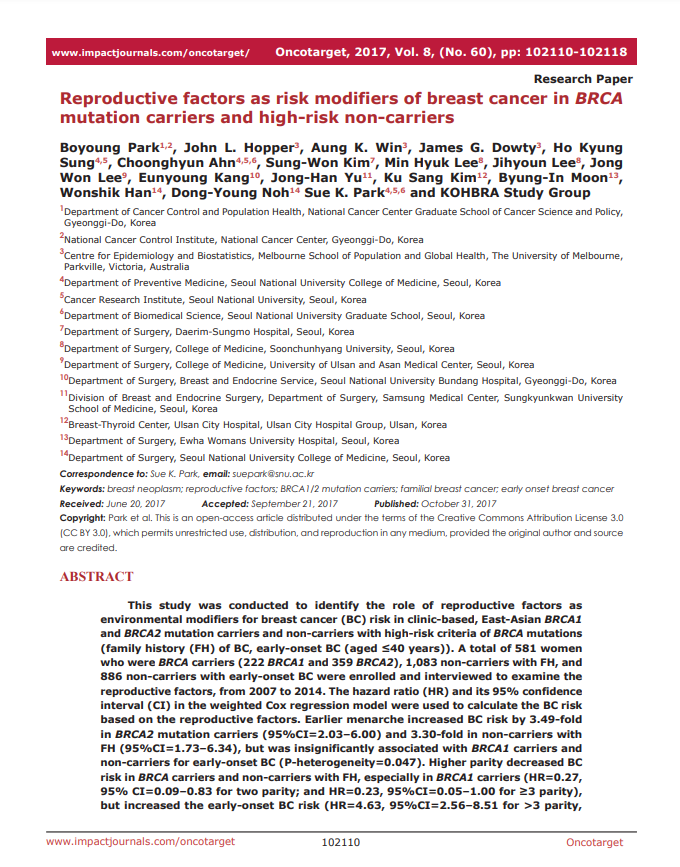
Oncotarget Reproductive factors as risk modifiers of breast cancer in BRCA mutation carriers and high risk 2017.10.31.Oncotarget. 2017 Nov 24; 8(60): 102110–102118. 논문 보기AbstractThis study was conducted to identify the role of reproductive factors as environmental modifiers for breast cancer (BC) risk in clinic-ba
sed, East-Asian BRCA1 and BRCA2 mutation carriers and non-carriers with high-risk criteria of BRCA mutations (family history (FH) of BC, early-onset BC (aged ≤40 years)). A total of 581 women who were BRCA carriers (222 BRCA1 and 359 BRCA2), 1,083 non-carriers with FH, and 886 non-carriers with early-onset BC were enrolled and interviewed to examine the reproductive factors, from 2007 to 2014. The hazard ratio (HR) and its 95% confidence interval (CI) in the weighted Cox regression model were used to calculate the BC risk ba sed on the reproductive factors. Earlier menarche increased BC risk by 3.49-fold in BRCA2 mutation carriers (95%CI=2.03–6.00) and 3.30-fold in non-carriers with FH (95%CI=1.73–6.34), but was insignificantly associated with BRCA1 carriers and non-carriers for early-onset BC (P-heterogeneity=0.047). Higher parity decreased BC risk in BRCA carriers and non-carriers with FH, especially in BRCA1 carriers (HR=0.27, 95% CI=0.09–0.83 for two parity; and HR=0.23, 95%CI=0.05–1.00 for ≥3 parity), but increased the early-onset BC risk (HR=4.63, 95%CI=2.56–8.51 for >3 parity, p-heterogeneity=0.045). Oral contraceptive (OC) use and longer estrogen exposure periods (≥30 years) were associated with an increased risk of early-onset BC (HR=3.99, 95%CI=1.65–9.67; HR=7.69, 95%CI=1.96–25.01), while OC use was not associated with BC risk in other groups and longer estrogen exposure had rather decreased risk for BC risk (both p-heterogeneity<0.001). Several reproductive factors as risk modifiers could heterogeneously be associated with BC among BRCA1/2 mutation carriers, non-carriers with FH, and early-onset BC non-carriers.
Total : 35개 (page : 1/3)
-
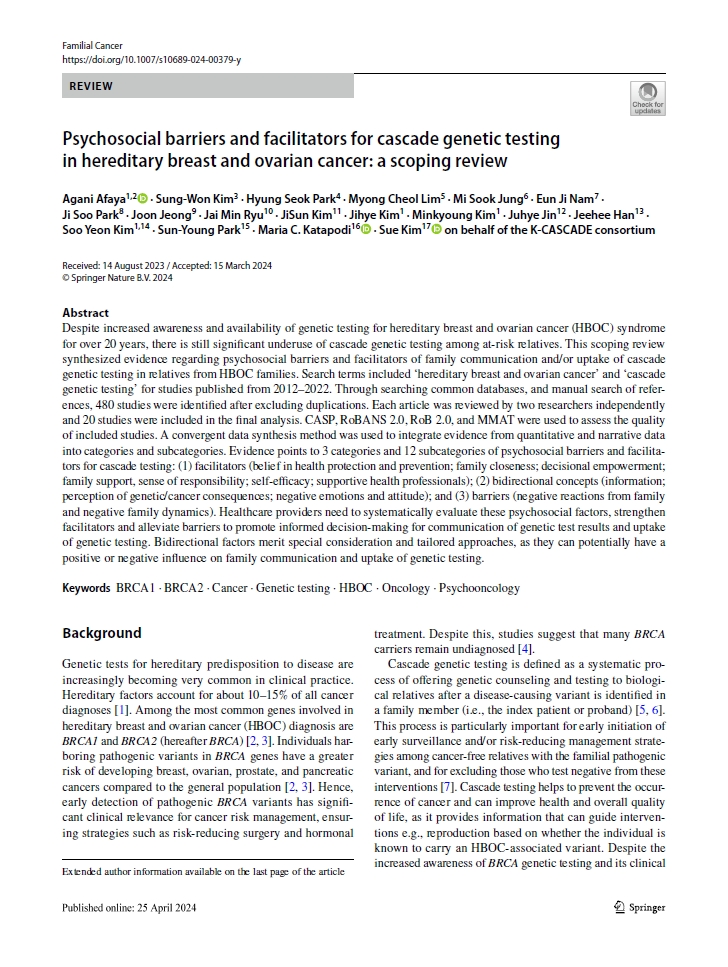 Psychosocial barriers and facilitators for cascade genetic testing in hereditary breast and ovarian cancer: a scoping review
-
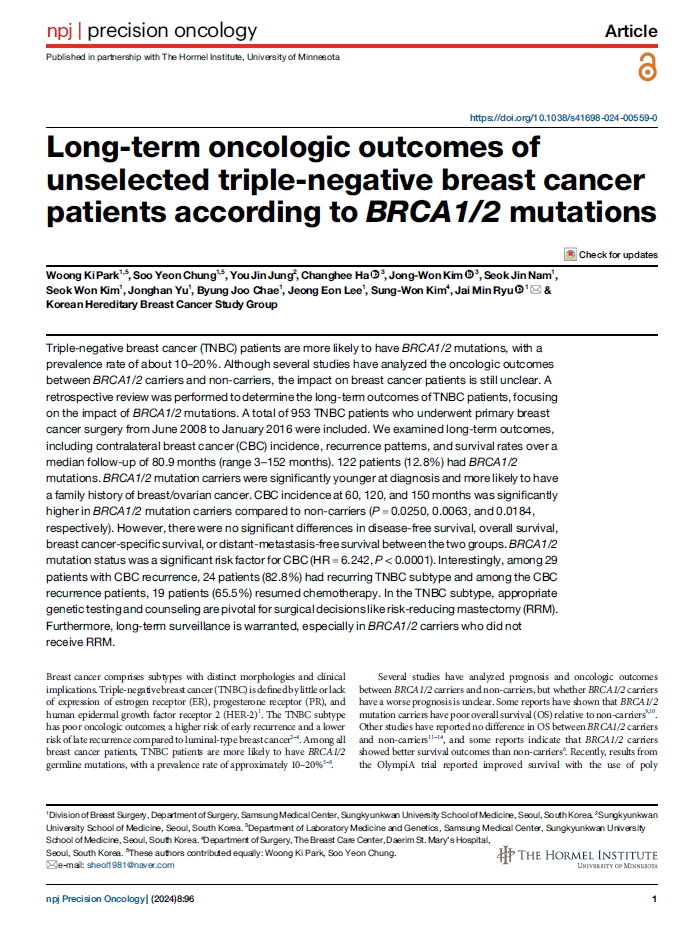 Long-term oncologic outcomes of unselected triple-negative breast cancer patients according to BRCA1/2 mutations
-
Associations of a Breast Cancer Polygenic Risk Score With Tumor Characteristics and Survival
-
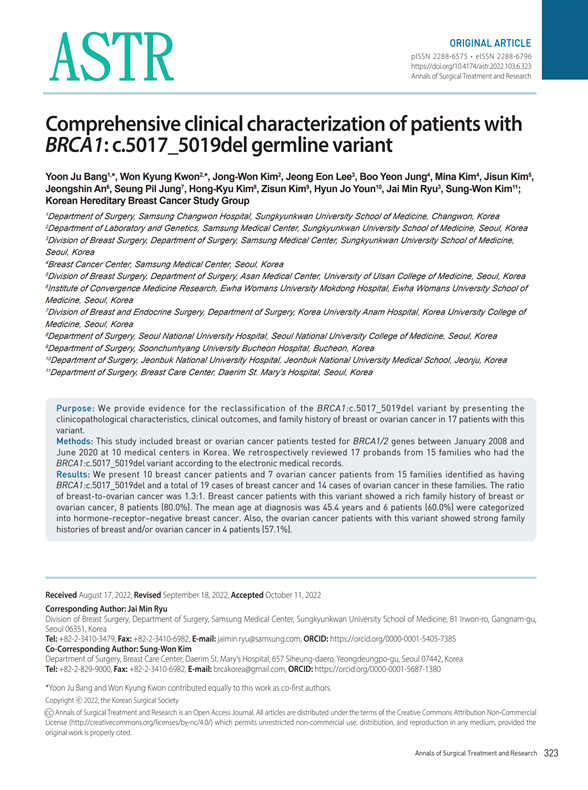 Comprehensive clinical characterization of patients with BRCA1: c.5017_5019del germline variant
-
 BRCA and Breast Cancer-Related High-Penetrance Genes
-
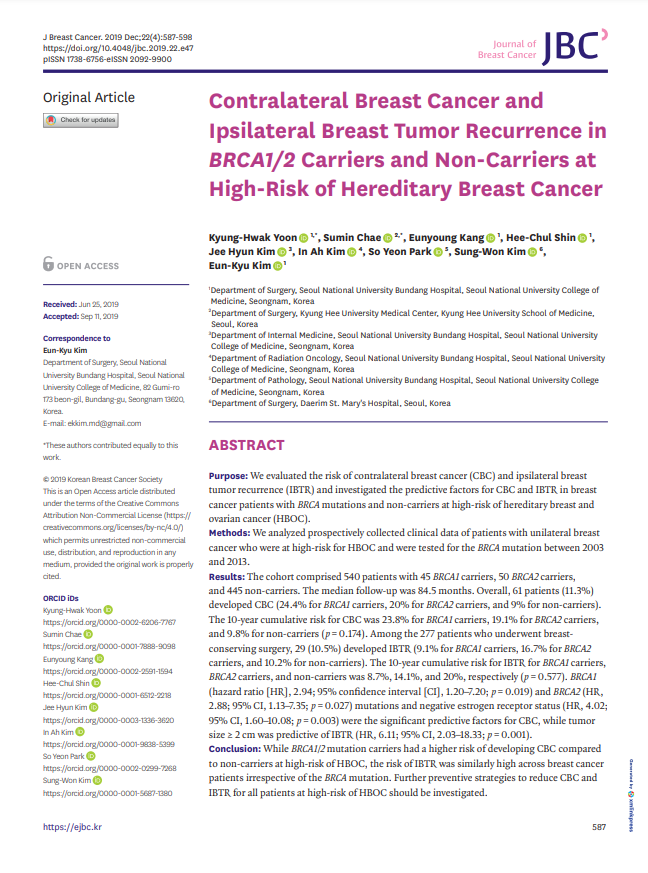 Contralateral Breast Cancer and Ipsilateral Breast Tumor Recurrence in BRCA1/2 Carriers and Non-Carriers at High-Risk of Hereditary Breast Cancer
-
 The functional ALDH2 polymorphism is associated with breast cancer risk: A pooled analysis from the Breast Cancer Association Consortium
-
 Height and body mass index as Modifiers of breast cancer risk in BRCA1/2 mutation carriers: A Mendelian randomization study
-
 Prevalence and oncologic outcomes of BRCA 1/2 mutations in unselected triple-negative breast cancer patients in Korea
-
 Development of a Management Algorithm for the Diagnosis of Cellular Fibroepithelial Lesions From Core Needle Biopsies
-
 Reclassification of BRCA1 and BRCA2 variants of uncertain significance: a multifactorial analysis of multicentre prospective cohort
-
 BRCA1/2-negative, high-risk breast cancers (BRCAX) for Asian women: genetic susceptibility loci and their potential impacts
-
 Impact of Nodule Size on Malignancy Risk Differs according to the Ultrasonography Pattern of Thyroid Nodules
-
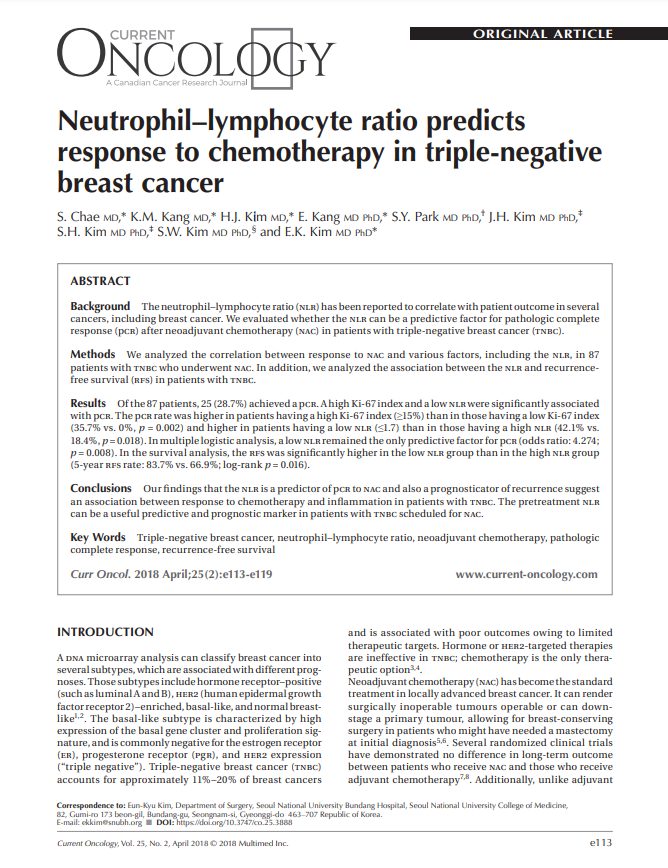 Neutrophil–lymphocyte ratio predicts response to chemotherapy in triple-negative breast cancer
-
 Identification of ten variants associated with risk of estrogen-receptor-negative breast cancer


