-
-
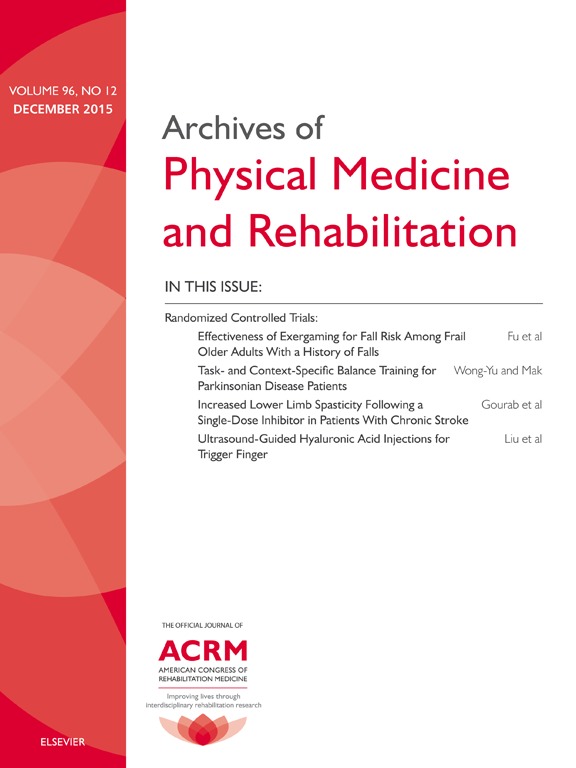
미국 재활 의학 학회지 Discrepant Trajectories of Impairment, Activity, and Participation Related to Upper-Limb Function in Patients With Breast Cancer 2015.09.03.Archives of Physical Medicine and Rehabilitation (VOLUME 96, ISSUE 12, P2161-2168, DECEMBER 01, 2015) 논문 보기ob
jectives To explore upper-limb disability with respect to health outcomes, operationalized by Disabilities of the Arm, Shoulder, and Hand, and to identify factors associated with each element of upper-limb disability over a 2-year period in breast cancer survivors.Main Outcome Measuresobjectives We evaluated demographics, social variables, and upper-limb disability in a baseline assessment preoperatively. Follow-up evaluations were conducted in outpatient clinics 3 months after surgery and at 12 and 24 months after surgery. Linear regression models with the generalized estimating equations of the compound symmetry covariance structure were used. ResultsTime since surgery was inversely associated with the impairment items score (β=−.20; 95% confidence interval [CI], −.49 to −.08) and positively associated with the activity limitation items score (β=.59; 95% CI, .29–.88). The impact of upper-limb disability preoperatively on the items involving both the activity limitation and participation restrictions scores was positive (β=2.89; 95% CI, .76–5.02) after adjusting for demographic, treatment type, and socioeconomic factors.ConclusionsOur study revealed that upper-limb impairment recovered with time after breast cancer surgery; however, upper-limb function-related activity and participation were reduced through 2 years after surgery.
Total : 35개 (page : 1/3)
-
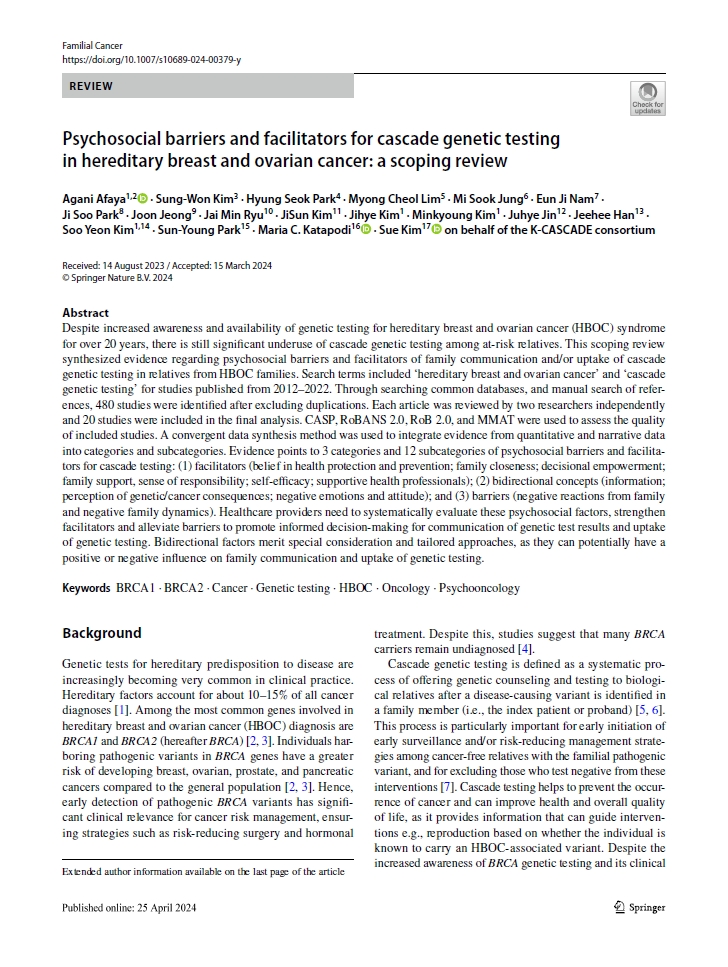 Psychosocial barriers and facilitators for cascade genetic testing in hereditary breast and ovarian cancer: a scoping review
-
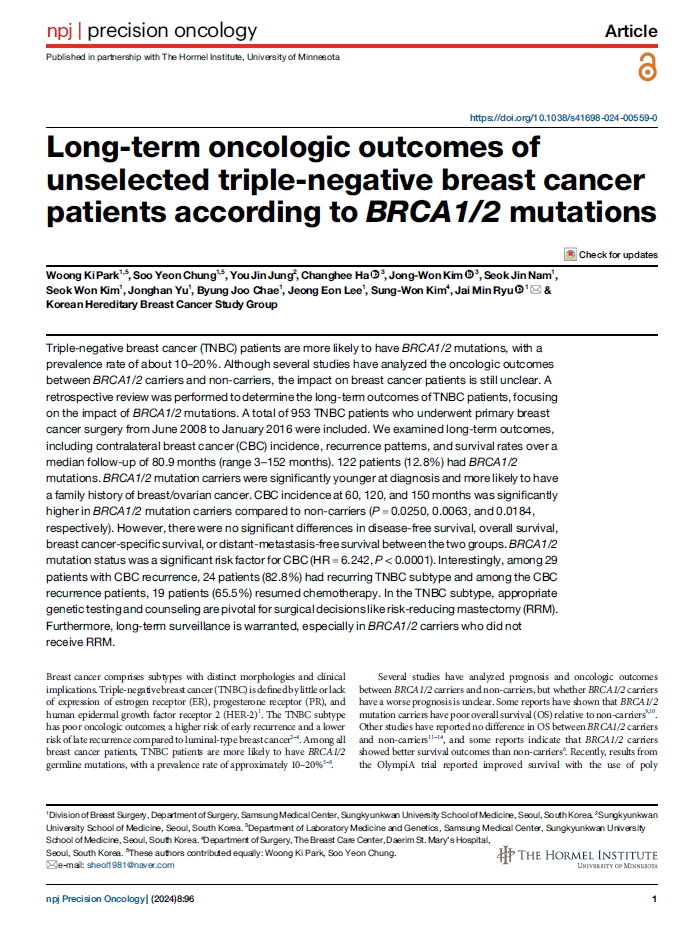 Long-term oncologic outcomes of unselected triple-negative breast cancer patients according to BRCA1/2 mutations
-
Associations of a Breast Cancer Polygenic Risk Score With Tumor Characteristics and Survival
-
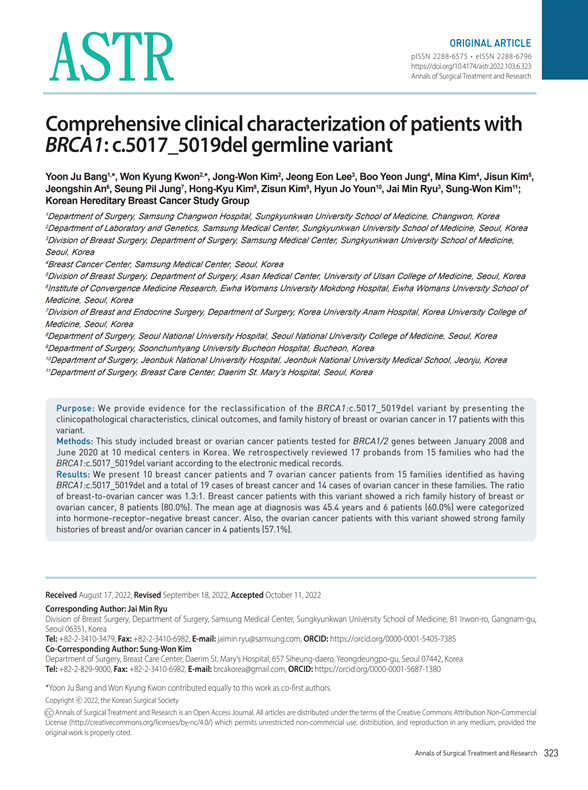 Comprehensive clinical characterization of patients with BRCA1: c.5017_5019del germline variant
-
 BRCA and Breast Cancer-Related High-Penetrance Genes
-
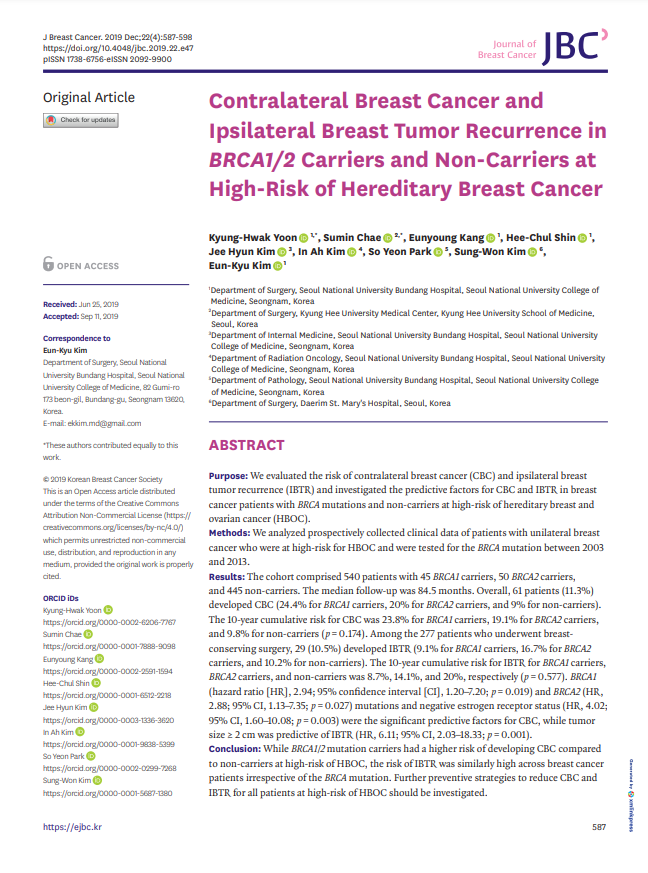 Contralateral Breast Cancer and Ipsilateral Breast Tumor Recurrence in BRCA1/2 Carriers and Non-Carriers at High-Risk of Hereditary Breast Cancer
-
 The functional ALDH2 polymorphism is associated with breast cancer risk: A pooled analysis from the Breast Cancer Association Consortium
-
 Height and body mass index as Modifiers of breast cancer risk in BRCA1/2 mutation carriers: A Mendelian randomization study
-
 Prevalence and oncologic outcomes of BRCA 1/2 mutations in unselected triple-negative breast cancer patients in Korea
-
 Development of a Management Algorithm for the Diagnosis of Cellular Fibroepithelial Lesions From Core Needle Biopsies
-
 Reclassification of BRCA1 and BRCA2 variants of uncertain significance: a multifactorial analysis of multicentre prospective cohort
-
 BRCA1/2-negative, high-risk breast cancers (BRCAX) for Asian women: genetic susceptibility loci and their potential impacts
-
 Impact of Nodule Size on Malignancy Risk Differs according to the Ultrasonography Pattern of Thyroid Nodules
-
 Neutrophil–lymphocyte ratio predicts response to chemotherapy in triple-negative breast cancer
-
 Identification of ten variants associated with risk of estrogen-receptor-negative breast cancer