-
-
Familial Cancer Psychosocial barriers and facilitators for cascade genetic testing in hereditary breast and ovarian cancer: a scoping review 2024.06.14.Volume 23, pages 121–132, (2024); 논문 보기
Abstract
Despite increased awareness and availability of genetic testing for hereditary breast and ovarian cancer (HBOC) syndrome for over 20 years, there is still significant underuse of cascade genetic testing among at-risk relatives. This scoping review synthesized evidence regarding psychosocial barriers and facilitators of family communication and/or uptake of cascade genetic testing in relatives from HBOC families. Search terms included 'hereditary breast and ovarian cancer' and 'cascade genetic testing' for studies published from 2012–2022. Through searching common databa
ses, and manual search of references, 480 studies were identified after excluding duplications. Each article was reviewed by two researchers independently and 20 studies were included in the final analysis. CASP, RoBANS 2.0, RoB 2.0, and MMAT were used to assess the quality of included studies. A convergent data synthesis method was used to integrate evidence from quantitative and narrative data into categories and subcategories. Evidence points to 3 categories and 12 subcategories of psychosocial barriers and facilitators for cascade testing: (1) facilitators (belief in health protection and prevention; family closeness; decisional empowerment; family support, sense of responsibility; self-efficacy; supportive health professionals); (2) bidirectional concepts (information; perception of genetic/cancer consequences; negative emotions and attitude); and (3) barriers (negative reactions from family and negative family dynamics). Healthcare providers need to systematically evaluate these psychosocial factors, strengthen facilitators and alleviate barriers to promote informed decision-making for communication of genetic test results and uptake of genetic testing. Bidirectional factors merit special consideration and tailored approaches, as they can potentially have a positive or negative influence on family communication and uptake of genetic testing.
- ▲ 이전글
[이전글이 없습니다.]
- ▼ 다음글 Long-term oncologic outcomes of unselected triple-negative breast cancer patients according to BRCA1/2 mutations 관**
Total : 35개 (page : 1/3)
-
Psychosocial barriers and facilitators for cascade genetic testing in hereditary breast and ovarian cancer: a scoping review
-
 Long-term oncologic outcomes of unselected triple-negative breast cancer patients according to BRCA1/2 mutations
-
Associations of a Breast Cancer Polygenic Risk Score With Tumor Characteristics and Survival
-
 Comprehensive clinical characterization of patients with BRCA1: c.5017_5019del germline variant
-
 BRCA and Breast Cancer-Related High-Penetrance Genes
-
 Contralateral Breast Cancer and Ipsilateral Breast Tumor Recurrence in BRCA1/2 Carriers and Non-Carriers at High-Risk of Hereditary Breast Cancer
-
 The functional ALDH2 polymorphism is associated with breast cancer risk: A pooled analysis from the Breast Cancer Association Consortium
-
 Height and body mass index as Modifiers of breast cancer risk in BRCA1/2 mutation carriers: A Mendelian randomization study
-
 Prevalence and oncologic outcomes of BRCA 1/2 mutations in unselected triple-negative breast cancer patients in Korea
-
 Development of a Management Algorithm for the Diagnosis of Cellular Fibroepithelial Lesions From Core Needle Biopsies
-
 Reclassification of BRCA1 and BRCA2 variants of uncertain significance: a multifactorial analysis of multicentre prospective cohort
-
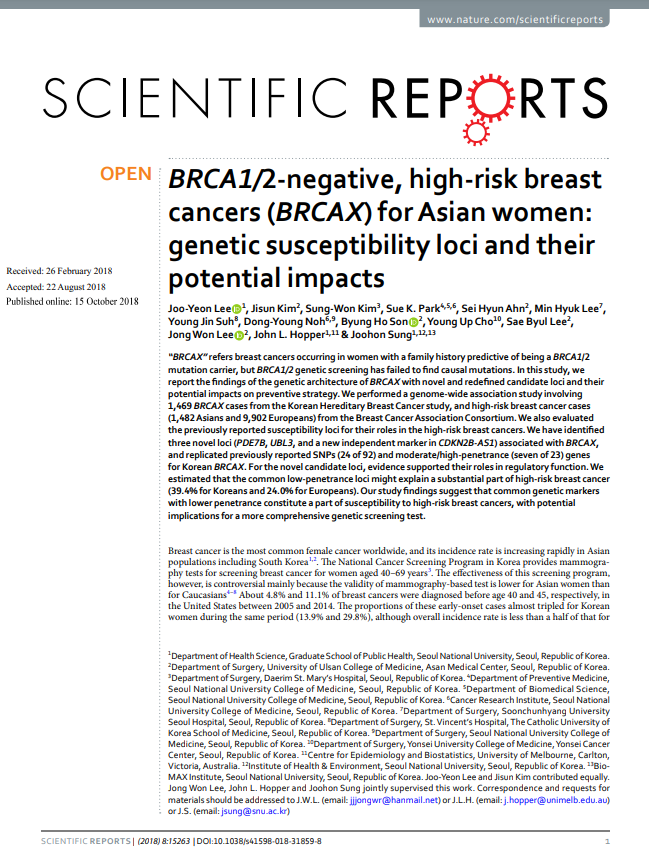 BRCA1/2-negative, high-risk breast cancers (BRCAX) for Asian women: genetic susceptibility loci and their potential impacts
-
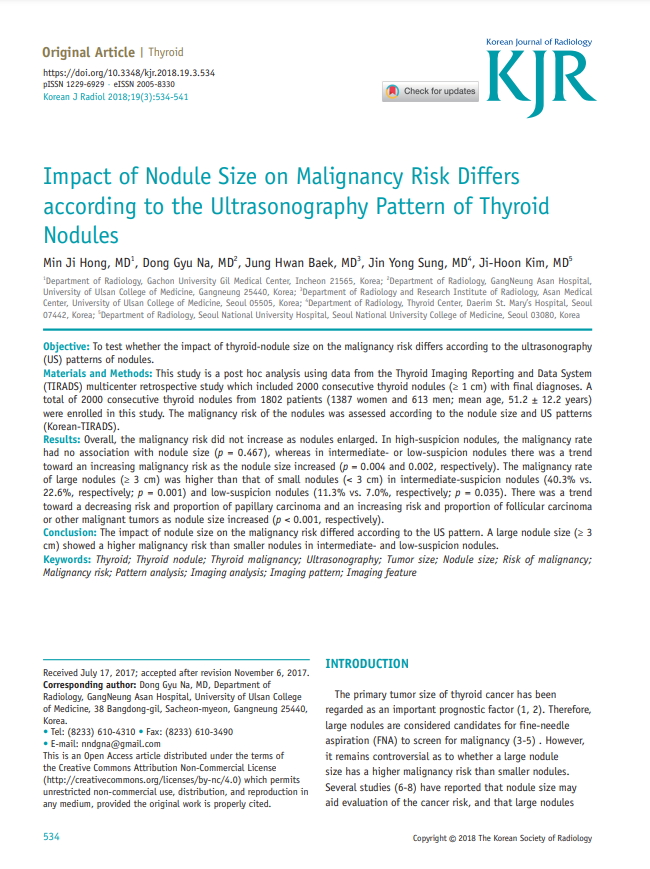 Impact of Nodule Size on Malignancy Risk Differs according to the Ultrasonography Pattern of Thyroid Nodules
-
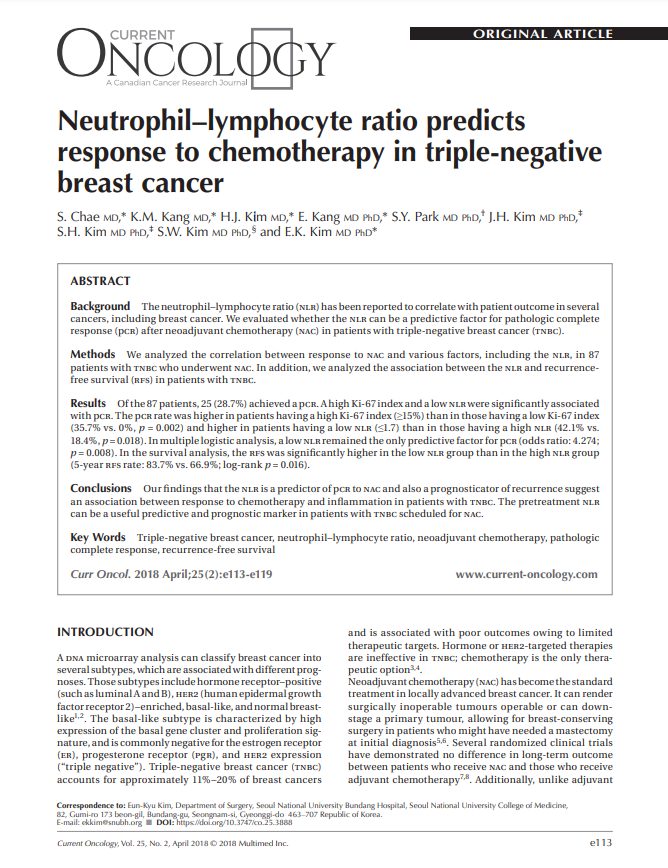 Neutrophil–lymphocyte ratio predicts response to chemotherapy in triple-negative breast cancer
-
 Identification of ten variants associated with risk of estrogen-receptor-negative breast cancer